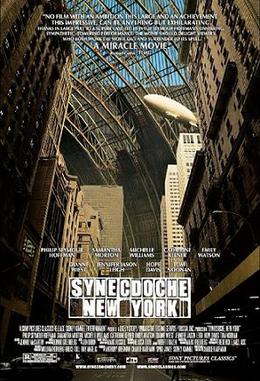
Caden's Regrets: What Synecdoche, New York Teaches About Wasting Time
Charlie Kaufman’s cinematic masterpiece, Synecdoche, New York, is a film often described as sprawling, complex, and even bewildering. Yet, beneath its labyrinthine structure and surreal shifts in reality, it offers a remarkably clear and profound message about the human condition: we don’t have much time, and we are alarmingly prone to wasting it. At the heart of this poignant exploration is Caden Cotard, played with heartbreaking brilliance by Philip Seymour Hoffman, whose life serves as a stark cautionary tale for anyone grappling with self-obsession, unfulfilled potential, and the fleeting nature of existence.
The Labyrinthine Life of Caden Cotard: Potential Down the Drain
Caden Cotard is introduced as a hypochondriac theater director, seemingly burdened by an acute awareness of his own mortality. He’s a man perpetually on the brink of something significant, yet always just out of reach. His life, as presented in Synecdoche New York, can be distilled into three fundamental components: his relationships, particularly with Hazel; his ambitious, ever-expanding play; and his tumultuous journey of self-discovery. In each area, the film meticulously details how potential, hope, and opportunities slip through his fingers, often due to his own inaction or misdirection.
- The Love Lost: Hazel. Caden’s connection with Hazel, his ticket agent and later lover, is perhaps the most heartbreaking illustration of squandered time. Their relationship is a series of missed opportunities, hesitant steps, and unspoken desires. By the time they finally achieve a semblance of peace and connection, sharing an intimate moment of genuine affection, Hazel is gone. Her lament, spoken just before her death – “I wish we had this when we were young. And all those years in between.” – encapsulates the film's central theme. It’s a bitter truth that resonates deeply: the realization of what could have been, arriving only when it’s too late to reclaim the lost years. This isn't just a romantic tragedy; it's a commentary on our human tendency to defer joy and true connection, always waiting for the "right" moment that may never come.
- The Endless Play: An Unfinished Magnum Opus. Caden’s magnum opus, a play designed to mimic life itself in excruciating detail, becomes an all-consuming monster that swallows decades. He receives a MacArthur “Genius Grant” for his work, yet the play remains in a perpetual state of becoming, never truly reaching its intended form. He constantly expands its scope, casting actors to play himself, his ex-wife, his daughter, and even the actors playing those roles. This artistic endeavor, meant to capture the essence of life, paradoxically keeps him from living it. It's a testament to the paralysis of perfectionism and the danger of an ambition so vast it becomes unattainable, substituting real experience for its simulated counterpart.
- The Delayed Self-Discovery: Too Late to Apply. Caden’s journey of self-understanding is equally fraught with delay. He spends years adopting different identities within his play, eventually living as Ellen, an actor playing Caden. While this experience ultimately leads to a clearer understanding of himself and the human experience, the knowledge arrives when he is old, infirm, and facing imminent death. The insight comes, but there is no time left to apply it in any meaningful way to his own life. The poignant irony is that the wisdom gained from a life fully lived, or even a life fully observed, is invaluable, but its impact is significantly diminished if acquired at the very end.
The Paralysis of Perfectionism and Self-Absorption
Caden’s struggle is not merely about bad luck; it’s deeply rooted in his personality. He is a profoundly self-obsessed hypochondriac, so consumed by his own anxieties and internal world that he fails to truly engage with the external one. The film suggests he is “too busy looking through others rather than looking at them.” This critical observation highlights a pervasive modern challenge: the difficulty of genuine connection in an age of constant self-reflection and curated personas. For Caden, his entire existence becomes a recursive loop of introspection, where his art mirrors his life, which then mirrors his art, preventing him from ever breaking free and truly experiencing reality. His quest for authenticity becomes an elaborate, inauthentic performance.
This obsession with perfection, particularly in his art, acts as a profound impediment. His play, meant to be a truthful representation of life, never feels complete because life itself is messy, ever-changing, and inherently imperfect. Caden’s inability to accept this messiness keeps him from ever concluding his work, and by extension, from truly living. His artistic ambition becomes a shield against actual vulnerability and connection, a way to control the chaos of existence rather than embrace it.
The Breakthrough: Every Lead in Their Own Story
The profound irony of Caden’s artistic journey is that the crucial breakthrough in his play – and by extension, his understanding of life – doesn't come from his own painstaking efforts but from yielding control. It happens when he steps to the periphery, allowing Millicent, an actress playing Caden, to take the reins. Millicent restages the funeral of Sammy, a character whose own life was a mirror to Caden's, but significantly, she removes Caden's character altogether from the scene.
This pivotal moment in Synecdoche New York is where the film delivers one of its most powerful philosophical insights. Caden had a theoretical understanding, articulating, “I know how to do it, now. There are nearly 13 million people in the world. I mean, can you imagine that many people? And none of those people is an extra. They’re all leads in their own stories. They have to be given their due.” He grasped the concept, but he never executed it. He never truly gave others their due within his own life or his own play, remaining the central, self-absorbed figure.
Millicent, however, *shows* us this idea. In her version of the funeral, a completely unknown, previously unintroduced pastor delivers one of the most powerful and moving scenes in the entire film. This character, an outlier with no previous or subsequent development, embodies Caden's stated truth: every person is the lead in their own story. The fact that an "extra" can deliver such a profound performance makes you wonder about the untapped potential and rich inner worlds of every single person we encounter, every passerby, every minor character in our own narratives. It shatters the notion of "main characters" and "side characters," revealing a universe where everyone holds the starring role in their own unique epic. This moment beautifully reinforces the film's core message, which you can explore further in Every Lead in Their Story: Synecdoche, New York's Deepest Message.
Practical Lessons from Caden’s Plight: Reclaiming Your Time
While Caden’s life in Synecdoche New York feels overwhelmingly tragic, it’s not without valuable lessons for us all. His experiences serve as a powerful mirror, urging us to examine our own lives and how we spend our precious, finite time.
- Embrace Imperfection and Act: Caden's relentless pursuit of an impossible perfection paralyzed him. Don't let the fear of failure or the desire for an ideal outcome prevent you from starting, creating, or connecting. Take imperfect action; life unfolds in the messy middle, not in some perfectly curated future.
- Prioritize Genuine Connection: Caden's greatest regret, echoed by Hazel, was the time lost in meaningful relationships. Actively seek out and nurture genuine connections. Put down the phone, look people in the eye, listen deeply, and express your feelings. Don't wait until it's too late to share "this" with the people you care about.
- Shift from Self-Absorption to Empathy: Caden was stuck "looking through" people. Challenge yourself to truly "look at" others. Recognize that everyone around you has a rich, complex inner world as intricate as your own. Practice empathy, listen to different perspectives, and step outside your own narrative bubble. This understanding can profoundly enrich your own life and connections.
- Live in the Present: Caden was always planning for a future he could never quite realize or dwelling on a past he couldn't change. While planning and reflection are important, ensure you are also fully present in the now. The "time in between," as Hazel lamented, is where life actually happens.
- Recognize the Value in Every Moment: The film brilliantly demonstrates that even seemingly insignificant moments, or characters on the periphery, hold immense value. Every conversation, every sunrise, every mundane task contributes to the rich tapestry of your existence. Don't dismiss them as mere "extras" in your own story. For a deeper dive into the film's core principles, consider Synecdoche, New York Explained: Understanding Its Simple Core Message.
Conclusion
Synecdoche, New York is more than just a film; it's a profound meditation on life, art, and the relentless march of time. Caden Cotard's tragic journey is a stark reminder of how easily we can get lost in our own heads, in endless projects, and in the pursuit of an elusive perfection, only to find that life has passed us by. The film doesn't offer easy answers, but it does shine a powerful light on the importance of presence, connection, and the recognition of shared humanity. By understanding Caden's regrets, we are given a chance to reflect on our own lives and perhaps, choose a different path – one that embraces the messy, imperfect, and beautiful reality of living fully, before our own time runs out.